
United States Mission Geneva, CC | https://creativecommons.org/licenses 2.0 via Wikimedia Commons
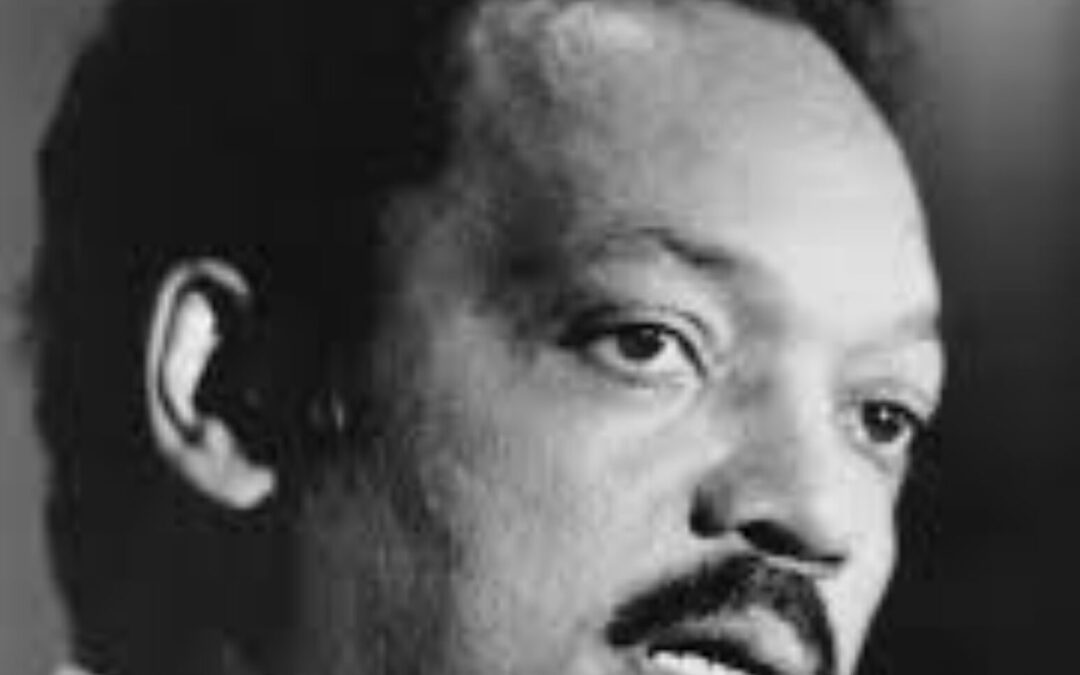
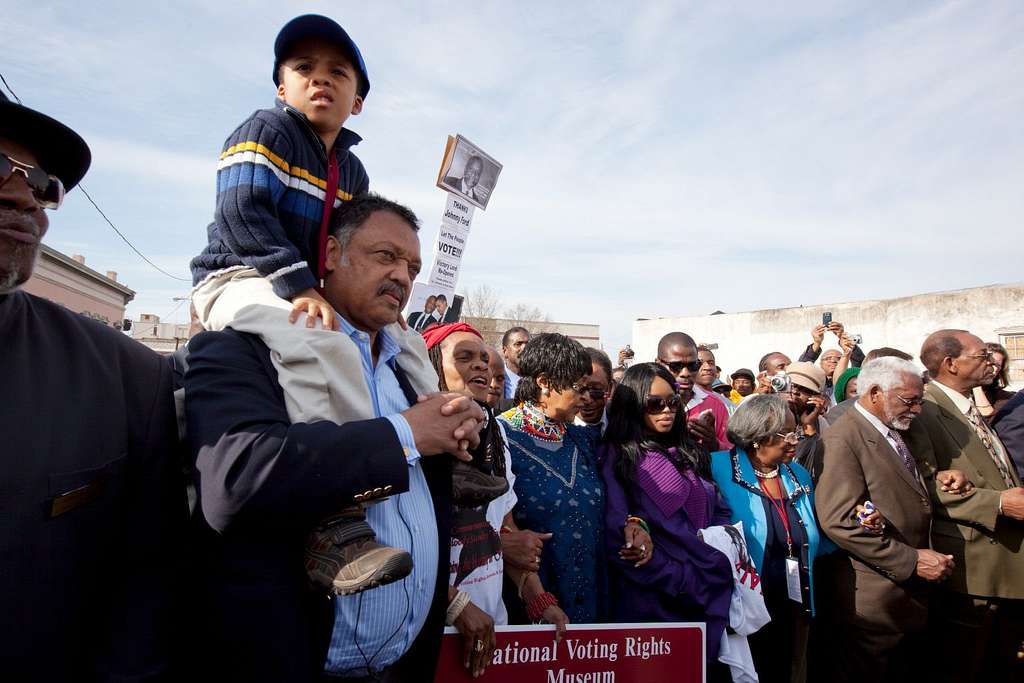
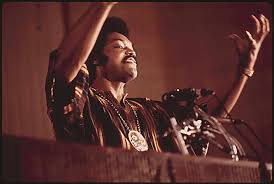
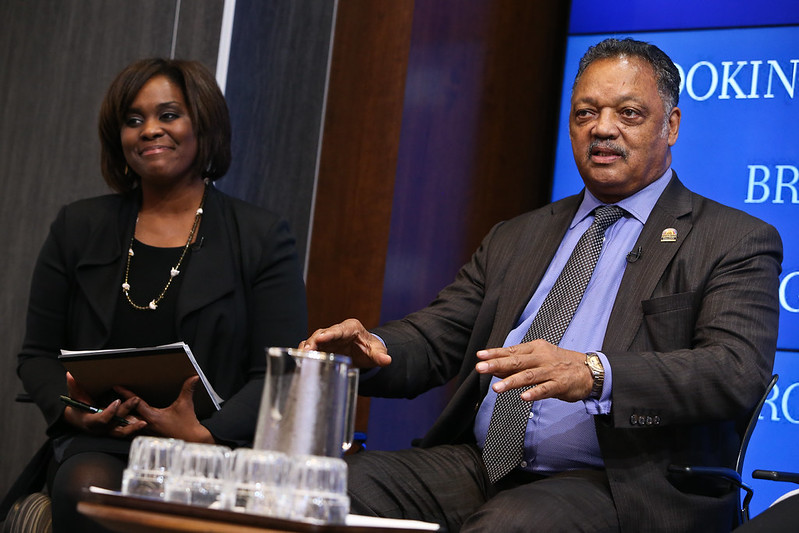
Reverend Jesse Jackson Sr. (October 8, 1941 – February 17, 2026) was a civil rights leader, presidential candidate, and founder of the Rainbow Coalition. He was also an infrastructure builder:
- The Chicago grocery store boycotts that forced A&P and other chains to hire Black workers into better-paid jobs? That created economic stability for thousands of families.
- The voter registration machinery from his presidential campaigns? Black women like Donna Brazile and Maxine Waters turned it into the political infrastructure they still lead on today.
- The health-equity platform published in the American Journal of Public Health? It shaped every fight for universal coverage and single-payer that followed.
Jackson’s legacy isn’t just speeches and symbolism. It’s the practical tools Black women are still using to build power.
From Grocery Store Boycotts to Corporate Contracts
In 1966, Jesse Jackson led the Chicago chapter of Operation Breadbasket for the Southern Christian Leadership Conference. The goal was clear: force white‑owned corporations to hire Black workers and stock Black‑owned products.
The wins were specific:
-
A&P grocery stores and other major chains faced sustained boycotts and agreed to expand hiring of Black employees, opening up more front‑of‑house and supervisory positions.
-
Dairy companies committed to employment agreements that opened more driver and distribution jobs for Black workers.
-
National brands, including Coca‑Cola, were pushed through Operation Breadbasket‑style campaigns to support Black employment and, in some cities, Black‑owned distributorships.
These weren’t symbolic gestures. They were paychecks. Benefits. Mortgages. College tuition. Pathways into the middle class.
For Black women, this meant something particular. The service and retail jobs Jackson’s campaigns helped open weren’t glamorous, but they were more stable and better paid than many other options. They came with hours you could count on, raises you could negotiate, and workplace protections. For women supporting families, that stability was power.
By 1971, Jackson had founded Operation PUSH (People United to Serve Humanity) to keep the pressure on. A decade later came the Rainbow Coalition, which later merged with PUSH into the Rainbow/PUSH Coalition—a national platform for economic‑justice campaigns that continued forcing corporate accountability.
When we talk today about corporate diversity commitments, supplier equity, and economic justice, we’re talking about tactics Jackson and his peers refined in Chicago in the 1960s and 1970s.
How Jackson’s Presidential Campaigns Became Leadership Academies for Black Women
History books remember Jackson’s 1984 and 1988 presidential campaigns as symbolic firsts. They were more than that. They were organizing schools.
Donna Brazile worked on Jackson’s 1984 presidential campaign and has often described how that experience sharpened her skills in field organizing and voter mobilization. She went on to become the first Black woman to manage a major presidential campaign (Gore 2000) and later to chair the Democratic National Committee—roles where those skills helped shape national Democratic infrastructure.
Maxine Waters—then a California assemblywoman—served as a national co‑chair of Jackson’s presidential campaigns and led the California operation. She didn’t just endorse him. She helped build coalition machinery, turn out voters, and prove that Black women could successfully run large‑scale political operations. That experience helped make her one of the most powerful members of Congress.
These women didn’t just support Jackson’s campaigns. They worked inside them and helped run them. And when the campaigns ended, they kept the infrastructure—the voter files, the volunteer networks, the proven strategies for turning out Black voters in hostile territory.
That’s why when people marvel at Black women’s voter‑turnout rates today, they’re seeing the fruits of seeds planted in those campaigns. Jackson got the podium. Black women built the ground game.
The Health Equity Plan Nobody Remembers (But Should)
Here’s what almost no tribute will mention today: In 1988, Jesse Jackson’s campaign published a formal health‑policy proposal in the American Journal of Public Health.
It’s called the Jackson National Health Program. It’s peer‑reviewed. It’s indexed in PubMed. And it outlined a universal, federally funded, single‑payer system designed explicitly to address inequities in access and care.
This wasn’t a stump‑speech promise. It was a detailed policy platform that connected civil rights to health outcomes decades before “health equity” became mainstream language. Jackson argued that communities can’t be free if they’re not healthy, that health care is a right, not a commodity, and that the government has a moral obligation to prioritize poor and working‑class communities in health policy.
For Black women, who face higher maternal mortality rates, more chronic disease, less access to quality care, and structural barriers tied to racism and poverty, this framework mattered. It named the problem as systemic, not individual. It demanded solutions at the policy level, not just the clinic level.
When Democrats attempted major health reform in the 1990s, they did so in a political environment where Jackson’s call for a National Health Program had helped put universal coverage on the party’s agenda. When debates over the Affordable Care Act and Medicaid expansion unfolded, they echoed a core principle Jackson had championed, that expanding coverage and public responsibility for health care is a matter of justice as well as policy.
The Jackson National Health Program didn’t pass. But it held space for an idea: that universal health care isn’t a handout, it’s justice.
At Community Hero PA, when we say health outcomes for Black women are shaped in policy and paychecks, not just clinics, we’re walking a path Jackson helped clear.
He didn’t just win concessions. He built infrastructure.
The Infrastructure Is Still Here. The Question Is What We Build Next.
Jesse Jackson’s campaigns didn’t just elevate him. They trained a generation of Black organizers—including Black women—who went on to run cities, state parties, and national campaigns.
His economic‑justice work didn’t just win contracts. It normalized the idea that Black communities could use collective power—boycotts, votes, organized pressure—to force institutional change.
His health‑equity platform didn’t become law. But it kept universal‑coverage and single‑payer ideas alive and reframed health care as a civil‑rights issue.
The infrastructure he built is still here. Voter‑registration strategies. Coalition‑building tactics. The moral case for economic and health equity.
Jesse Jackson showed us that power is built, not given. The best way to honor that legacy is to keep building, for the Black women who come after us, for our communities, for our families.
AP Images
United States Mission Geneva, CC BY 2.0 via Wikimedia Commons
Rev. Jesse Jackson, Sr. participating in the discussion, flanked by Nicol Turner-Lee.” by Brookings Institution, CC BY-NC-ND 2.0
References
- “Jesse Jackson.” Wikipedia.
- “Jesse Jackson | Civil rights, health, accomplishments.” Encyclopaedia Britannica.
- “The Rev. Jesse Jackson, who led the Civil Rights Movement for decades after King, has died at 84.” WTOP.
- “Rev. Jesse Jackson, a civil rights icon, dies at 84.” NBC News.
- “Jesse Jackson, Civil Rights Leader and Presidential Hopeful, Dies at 84.” Time.
- “Operation Breadbasket.” Wikipedia.
- “Operation Breadbasket.” George Eastman Museum.
- “The More Things Change… Golden Legacy, Affirmative Action & Black Comics.” The Middle Spaces (section on Operation Breadbasket and supermarket boycotts).
- “How Jesse Jackson Inspired Generations of Black Democrats.” The New York Times.
- “Jesse Jackson, Civil Rights Leader and Presidential Hopeful, Dies at 84.” Time.
- Himmelstein, D. U., et al. “The Jackson National Health Program: A Single‑Payer Proposal.” American Journal of Public Health, 1988.
- “The Jackson National Health Program.” PubMed entry.
- “The Birth and Death of Single‑Payer in the Democratic Party.” Jacobin.
- “Donna Brazile.” Los Angeles Sentinel.
- “Donna Brazile.” Ballotpedia.
- “Donna Brazile.” Wikipedia.
- “About Maxine.” Official U.S. House biography of Rep. Maxine Waters.
- “Jesse Jackson’s Run for the Presidency.” Floor statement by Rep. Maxine Waters, U.S. House of Representatives, November 17, 2009.
- “Jesse Jackson 1988 presidential campaign.” Wikipedia.
- “Jesse Jackson.” Wikipedia (sections on Operation PUSH and Rainbow Coalition).
- National Academies of Sciences, Engineering, and Medicine. “The Future of Nursing 2020–2030: Charting a Path to Achieve Health Equity.”
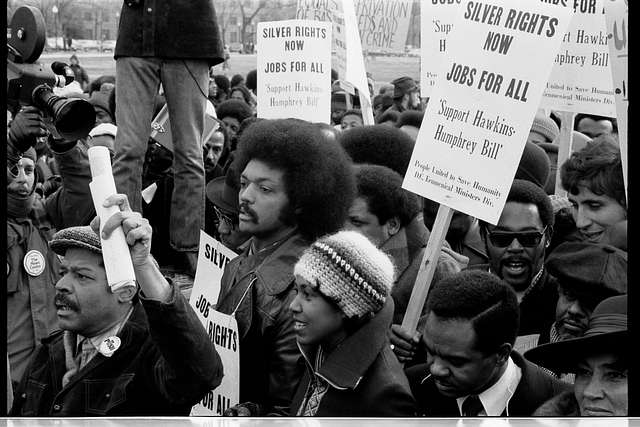
Library of Congress-http://www.loc.gov/
0 Comments